How a Pipe Cleaner Dragon Is Made, Step by Step
2026-09-20 · by Lumi atelier · Fujian, China
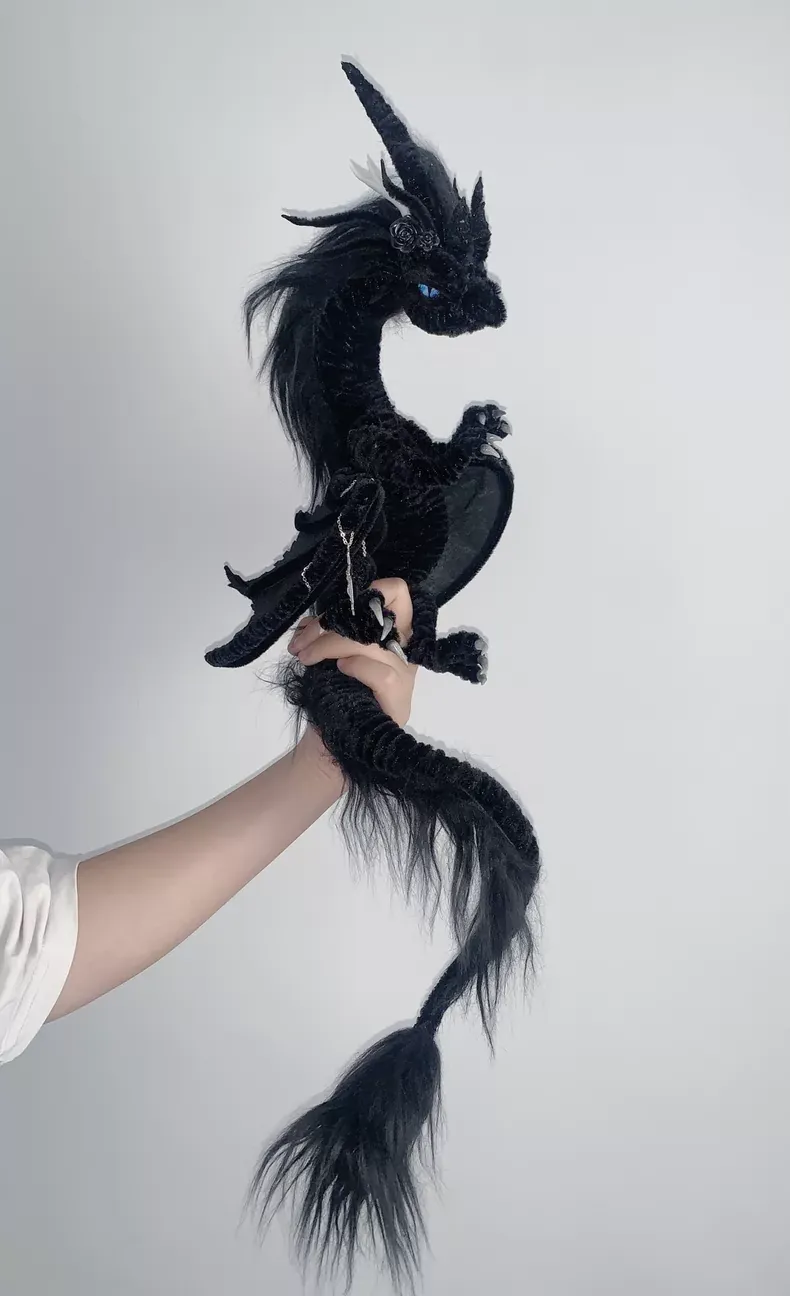
People assume a pipe cleaner dragon is a craft-project object — the sort of thing made at a kitchen table in an afternoon. The material is the same, but the way these are built is not. Here is what actually happens between a bundle of chenille and a finished dragon.
The material
A pipe cleaner — chenille, in the trade — is a length of twisted wire with fibre caught in the twist. Two properties matter:
- The wire core holds a shape. Bend it and it stays bent. This is what makes a dragon poseable rather than floppy.
- The fibre wrap hides the wire. It is what you actually see, and it is what gives the piece its colour and softness.
Everything below is a way of using those two properties.
1. Choosing the colourway
Before anything is shaped, the colours are decided. A dragon is rarely one colour — the body, the accents along the spine, and the detailing at the head are usually different, and the combination is what makes a colourway recognisable.
On a custom order this is where the work happens: matching a reference photo, and checking how the colours sit next to each other in real light rather than on a screen.
2. Building the core
The body starts as a wire armature. This is the skeleton, and it is the step that determines whether the finished piece looks like it is moving or looks like it is lying down.
Longer tiers — the $239 and $299 pieces — need a longer and more carefully tapered core, because the body curve has to read from across a room. This is also why the shorter tiers are quicker: less armature, fewer decisions.
3. Wrapping
Chenille is wrapped along the core, Working in sections so the fibre lies in a consistent direction. The direction matters more than it sounds — wrap one section against the nap of the section before it and the two read as different colours under a lamp.
This is also the slowest step. There is no way to speed it up without the wrap going uneven.
4. Shaping segment by segment
The body is shaped in segments rather than as a whole. Each segment is bent, checked against the one before it, and adjusted. It is iterative — the curve of the body is the sum of a lot of small corrections, not one decisive bend.
Two consequences:
- No two pieces are identical. Same colourway, same tier, same maker, and the curve will still differ slightly. That is the point of handmade, but it is worth knowing before you order.
- You can adjust it at home. The wire core is designed to be reshaped. Support both sides of a curve and make small corrections.
5. Head and detailing
The head is where a dragon stops being a decorated tube. It is the fiddliest part and the part that takes the longest to get right, which is why the longer tiers — with more detailing — cost more and take longer.
6. Check, photograph, pack
Before anything ships it is checked against the order, then photographed. We send those photos to you for confirmation — you see the exact piece you are getting before it leaves the workshop.
Packing is then reinforced, particularly for the longer tiers, because a dragon is light but bulky and a crushed body is the one damage that cannot be brushed out.
Where this happens
Lumi atelier is based in Fujian, China. Every piece is made by hand in our own workshop. Our story began with balloon parties and photography — years of decorating celebrations and capturing how people react when they are handed something made for them. That is still the part we care about most.
Nothing is made in advance and stored. Every piece starts after an order is confirmed.
Frequently asked questions
How long does one take to make?
Around 3 days from confirmed order to finished piece, plus shipping. Orders are made in sequence and overseas orders are prioritised.
Why do two dragons in the same colourway look slightly different?
Each segment is shaped by hand. The curve is the sum of many small corrections, so no two come out identical.
Can I reshape it myself?
Yes. The wire core is meant to be adjusted — support both sides of a curve and make small corrections rather than one large bend.
What is the wire made of?
A twisted wire core wrapped in chenille fibre. The core holds the shape; the fibre is what you see.
Do you make these in advance?
No. Everything is made to order — nothing is pulled from stock.
Every piece is made to order in Fujian. Custom colors, sizes and wholesale are welcome.
Start a custom order