How to Measure a Dog's Neck for a Collar (the Two-Finger Rule)
2026-09-28 · by Lumi atelier · Fujian, China
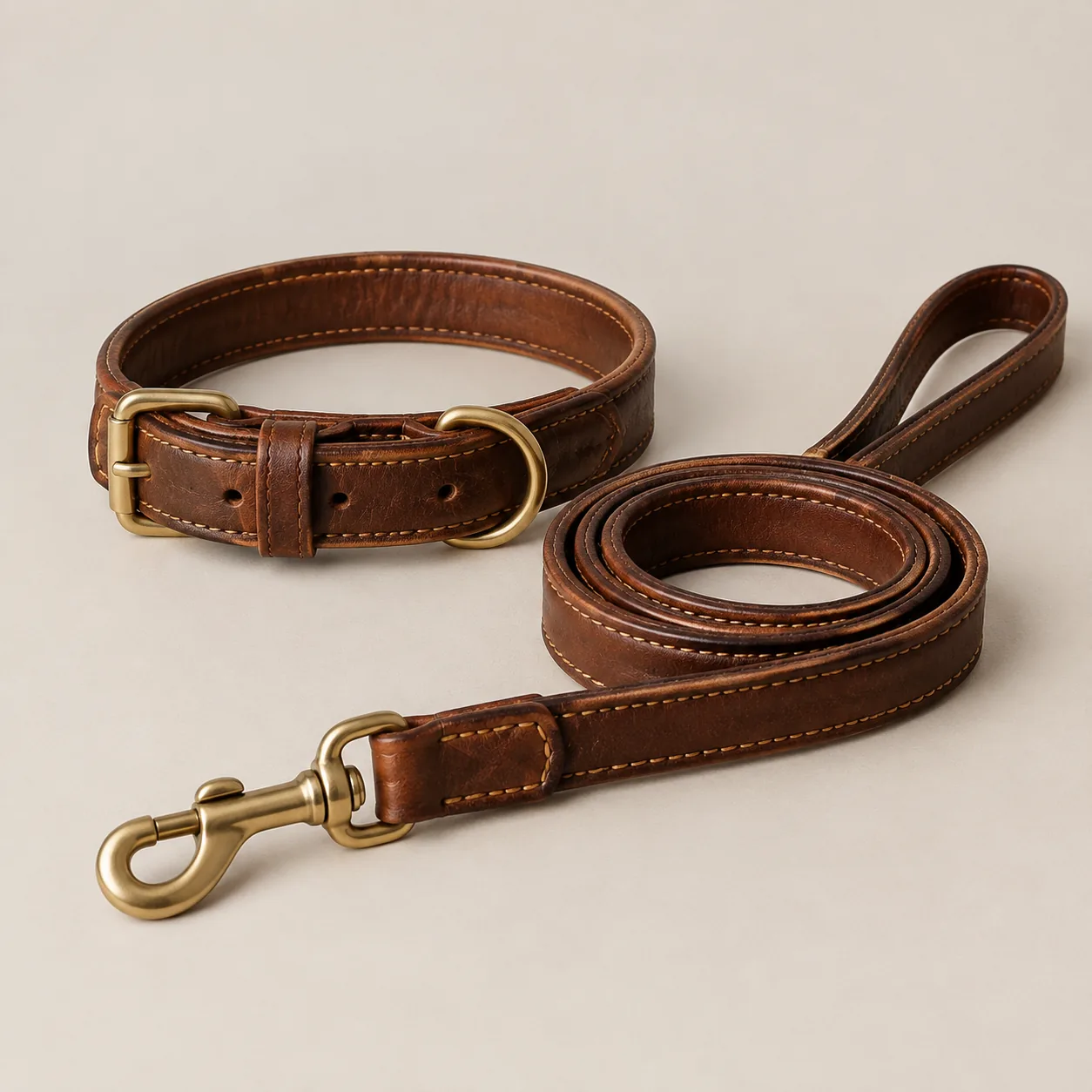
To measure a dog's neck for a collar, wrap a soft tape around the neck at the point where the collar will sit — high up, just behind the ears, not down by the shoulders. Read the number, then add 2–5 cm depending on coat thickness. When the collar is on, two fingers should slide flat between collar and neck.
That last check is the one that matters. Everything else is a starting point.
Where exactly do I put the tape?
High on the neck, just behind the ears and above the widest part of the shoulders. This is where a collar naturally sits and where it cannot slip off.
The two mistakes people make:
- Measuring too low, down near the shoulders, where the neck is wider. This gives a number several centimetres too large, and the collar then sits loose enough to slip over the head.
- Measuring the head, which is how people try to guarantee a collar cannot come off. It works, but it gives a collar far too big for the neck, which is uncomfortable and lets the dog catch a leg through it.
Keep the tape flat, no twist, and snug but not tight. You should be able to slide one finger under the tape as you measure.
How much should I add?
The addition is for coat, comfort and growth:
| Coat type | Add to the measurement | Why |
|---|---|---|
| Short, smooth (beagle, boxer, pug) | +2 to +3 cm | Little coat to account for |
| Medium (labrador, border collie, cocker) | +3 to +4 cm | Coat lifts the collar off the skin |
| Thick or double-coated (husky, samoyed, golden) | +4 to +5 cm | Heavy coat adds real bulk |
| Puppies still growing | +5 cm, or buy adjustable | Neck circumference changes fast |
Then apply the two-finger test. Slide two fingers flat between collar and neck. They should go in with slight resistance — not a struggle, not loose enough that a third finger fits.
Too loose and the dog can back out of it, or catch a lower jaw or a front leg in the gap. Too tight and it rubs the coat away and can cause a pressure injury at the throat.
What size by breed?
A starting point only — every dog varies, and this table is a way to sanity-check your own measurement rather than replace it.
| Build | Neck circumference | Typical breeds |
|---|---|---|
| Toy / small | 20–30 cm | Chihuahua, Yorkshire terrier, Maltese |
| Small | 28–38 cm | Pomeranian, miniature poodle, shih tzu |
| Medium | 35–50 cm | Beagle, cocker spaniel, border collie |
| Large | 45–65 cm | Labrador, golden retriever, boxer, husky |
| Giant | 60–90 cm | Great Dane, mastiff, Newfoundland |
If your measurement and the table disagree, trust your measurement. Breed ranges overlap heavily, and mixed-breed dogs in particular rarely sit where their apparent breed suggests.
Should the collar be adjustable or fixed?
This depends entirely on whether the dog is still growing.
- Puppies and dogs under 18 months: adjustable, without question. A puppy's neck can change several centimetres in a few months, and a fixed collar bought to fit will not fit by the time it wears out.
- Adult dogs at stable weight: a fixed collar in a measured size is neater, has no dangling strap end, and is what you want for a made-to-order piece.
For a made-to-order collar, send the measurement plus the dog's age and breed, and say whether the coat is thick. That is enough to get the fit right first time.
Does collar width matter?
It does, and it scales with the dog:
- Narrow (1–1.5 cm): small breeds and puppies. A wide collar on a small neck looks bulky and can rub the throat.
- Medium (2–2.5 cm): most medium dogs. The everyday choice.
- Wide (3 cm and above): large and strong-pulling breeds. Width spreads the load across the neck, which is the point — a narrow collar on a dog that pulls concentrates all the force onto a thin strip.
The general rule: the collar should cover roughly one-eighth of the neck's length, and the dog's head should be visibly wider than the collar.
What about the buckle and hardware?
Hardware adds weight and bulk, and on small dogs it can dominate the collar entirely. Two things to check:
- Weight. A heavy brass buckle on a 25 cm neck pulls the collar round so the buckle sits at the throat. On small breeds, choose light hardware.
- Thickness. Thick hardware sits proud of the collar and catches on bedding and crate edges. A flat, low-profile buckle is more comfortable for a dog that lies down a lot.
Also check where the D-ring sits. If tags hang from the D-ring, they should hang where the dog cannot chew them — usually at the side or back of the neck, not directly under the chin.
How often should I re-check the fit?
More often than you would think:
- Puppies: every two to three weeks during growth.
- Adult dogs: every three months, and after any weight change.
- Thick-coated breeds: at the start of every season. A winter coat and a summer coat can differ by two collar sizes.
Do the two-finger test each time. It takes two seconds and it is the only check that accounts for coat, weight and hardware together.
Frequently asked questions
Two fingers or one?
Two, flat, with slight resistance. One finger means it is too tight; three means it is loose enough to slip.
My puppy's neck keeps changing. What should I buy?
An adjustable collar, or an adult-size collar with the measurement re-checked monthly. Do not buy a fixed made-to-order collar for a dog under 18 months unless it is deliberately roomy.
Can I use a fabric tape measure?
Yes, and it is the best tool for the job. A metal tape from a toolbox is too stiff to sit flat around a neck and will read large.
Should I measure the old collar instead?
It is a decent cross-check: lay the old collar flat and measure from the buckle end to the hole that is actually used, not to the tip. Compare that with the fresh neck measurement. If they disagree, the neck measurement wins.
What if my dog is between sizes?
Choose the larger size and say so when ordering. On a made-to-order collar, an extra hole can be punched; a collar that is too short cannot be lengthened. --- Every collar in our pet collection is made to order in Fujian, so your dog's actual neck measurement goes into the piece rather than into a generic size chart. Sizes, materials and current options are on the Lumi atelier Pets shop. Send us the neck measurement, breed and coat type on WhatsApp and we will confirm the fit before making it.
Free printable measuring tape & size chart
A printable measuring tape plus our size chart for bracelets, rings, collars and pet clothing, in centimetres and inches. Print it at 100% scale, measure at home, and send us the number — we will confirm the size before you order.
One email with the printable chart. No newsletter, no reselling your address. Reply "stop" to unsubscribe.
Every piece is made to order in Fujian. Custom colors, sizes and wholesale are welcome.
Start a custom order