Gemstone or Glass Bead? How to Tell What You Are Actually Buying
2026-09-28 · by Lumi atelier · Fujian, China
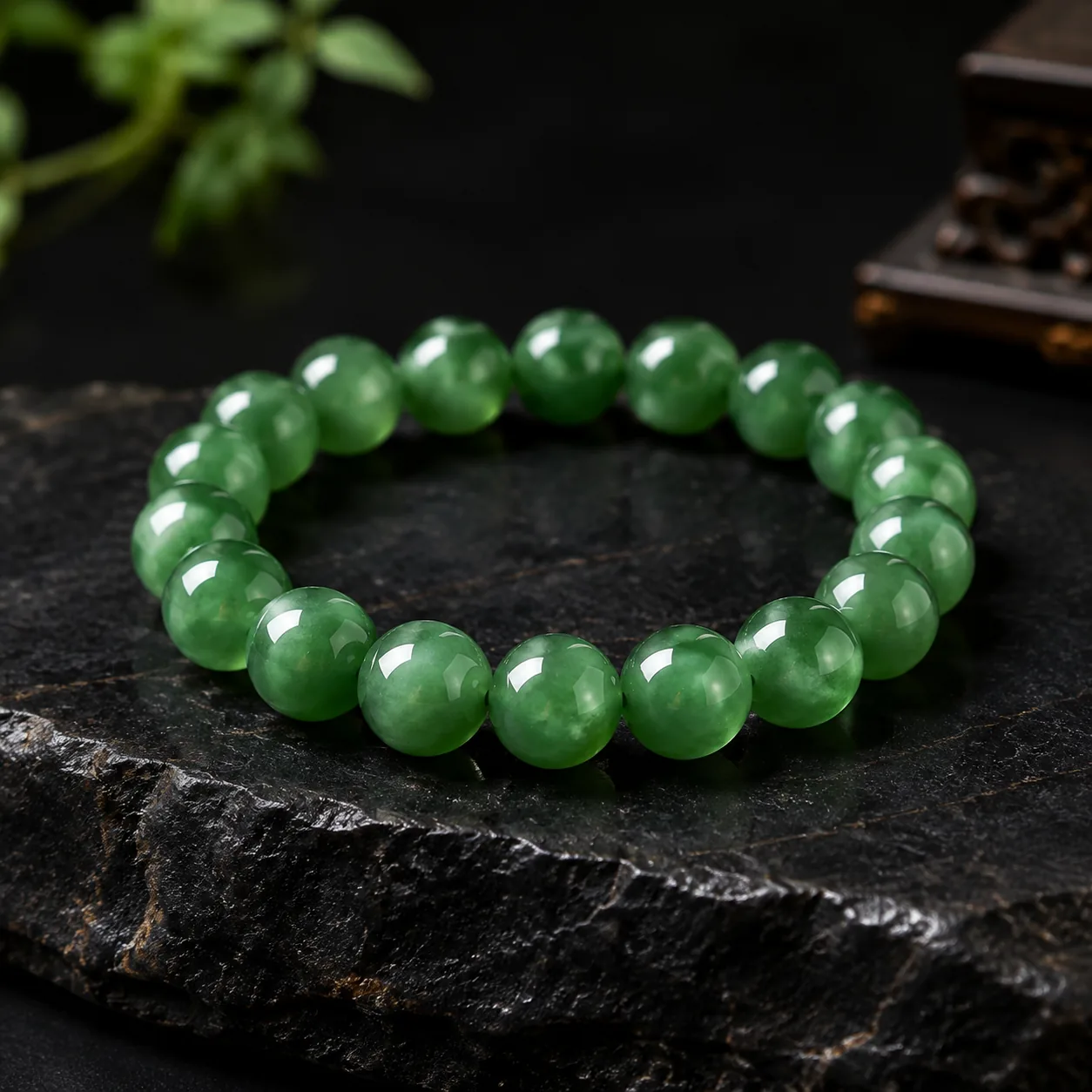
Hold the bead against your cheek for five seconds. Natural stone stays cool and warms slowly; glass reaches skin temperature almost immediately. Then look for variation: real stone beads differ slightly from one another in tone and usually show tiny internal lines or specks. Glass beads in a strand are near-identical and often contain small round bubbles.
That is the whole test in one paragraph. The rest of this article is why it works, where it fails, and what to ask a seller so you never have to guess.
Why does temperature tell you anything?
It comes down to thermal conductivity — how fast a material moves heat. Crystalline stone conducts heat away from your skin faster than glass does, so it keeps drawing warmth and feels cool for longer. Glass is a poor conductor; the surface warms to your temperature within a few seconds and then feels neutral.
The test is not perfect. A very small bead has little mass and will warm quickly whatever it is made of, and a bead that has been sitting in a warm room starts at a disadvantage. Use it as a first signal, not a verdict.
What does "inclusion" mean and why does it matter?
An inclusion is anything trapped inside a stone as it formed — a mineral speck, a fracture line, a cloud of tiny crystals. They are proof that the material grew in the ground rather than in a furnace.
Under a bright light, look into the bead rather than at its surface:
- Natural stone: fine veining, small mineral flecks, slight colour shift from one side to the other, occasional internal fractures that catch the light.
- Glass: perfectly round bubbles (a giveaway — bubbles in nature are never spherical), swirl marks from stirring, and absolutely uniform colour throughout.
Dyed howlite sold as turquoise is the classic case. Howlite is a real stone, so it passes the temperature test, but the colour sits in the veins in a way turquoise never does. If the blue looks like it was painted into the cracks, it was.
Are the beads in a strand identical?
This is the fastest check of all, because it needs no equipment.
Lay the strand flat and compare beads to their neighbours. Natural stone is cut from rough that varies within a single batch, so no two beads match exactly — one will be a shade darker, one will have a vein the others lack, one will be very slightly out of round. That variation is not a defect; it is the material behaving like a material.
Glass and synthetic beads are produced to a specification. Every bead is the same size, the same colour, the same everything. Uniformity at that level is the sign of manufacture, not mining.
What about weight?
Natural stone is denser than glass. A strand of 8 mm amethyst beads will feel noticeably heavier in the hand than a strand of 8 mm glass beads of the same count. You do not need scales — pick up both if you can, and the difference is obvious.
Two exceptions worth knowing:
- Freshwater pearl is lighter than most stone and has a distinctly gritty feel when rubbed gently against a tooth. Glass imitations feel perfectly smooth. (The tooth test is old, effective, and safe on real pearl.)
- Lacquer-coated beads — a core material finished with layers of lacquer — sit between the two in weight, and the surface has a depth you can see into, unlike the flat surface of coloured glass.
Does the price tell you the answer?
Usually, but not always. Natural stone costs more per bead because rough has to be selected, cut, drilled and polished, and drilling losses are high — a badly placed drill hole ruins a bead that has already been cut. Glass is pressed or drawn in volume.
So a strand of tiger's eye at the same price as a strand of glass beads in the same size should raise a question. Ask what the material is. A seller who knows their stock will answer with the name of a stone, not with "stone beads" or "natural."
What should I ask a seller before buying?
Four questions, and the way they are answered tells you everything:
- "Is this natural stone, dyed stone, or glass?" — a straight answer names the material. Vagueness here is the answer.
- "Is the colour natural or dyed?" — plenty of real stone is dyed to improve the colour, which is normal and fine, but you should be told.
- "Can I see the strand I will receive, not a sample photo?" — made-to-order sellers can usually photograph your actual strand before it ships.
- "Do the beads vary?" — if the answer is "no, they are all identical," you are probably looking at glass.
Is glass bad?
No, and it is worth saying plainly. Good glass has its own place: it takes colour that no natural stone produces, it is perfectly consistent when a design depends on that, and it costs a fraction of the price. Problems only start when glass is sold as stone.
What matters is that the label matches the object. A £15 glass bead bracelet sold honestly as glass is a good buy. The same bracelet sold as "natural amethyst" is not.
How do I care for each?
| Material | Care |
|---|---|
| Natural stone | Wipe with a soft dry cloth. Avoid perfume and hairspray. Keep out of long direct sun — some stones fade. |
| Freshwater pearl | Wipe after wearing. Store flat, away from harder stones that can scratch it. |
| Lacquer bead | Do not soak. Avoid solvents and alcohol. Wipe with a barely damp cloth. |
| Glass | Warm water and mild soap is fine. Dry before storing. |
Store each piece separately. Stones are harder than glass and will scratch it, and metal findings scratch both.
Frequently asked questions
Is dyed stone still "natural"?
The base is natural, the colour is not. Dyeing is common and accepted — the point is disclosure, not purity. Ask, and expect a straight answer.
Will natural stone fade?
Some will. Amethyst and rose quartz can lighten with long exposure to strong sunlight. Store pieces out of direct sun and this is rarely a problem.
How can I check at home without tools?
Temperature, then variation, then bubbles. Those three cover most cases. A 10x jeweller's loupe costs very little and makes inclusions obvious.
Why do beads in my stone strand have slightly different colours?
Because they were cut from the same piece of rough at different points, and the rough was not uniform. This is expected and is part of what you are buying.
Do you tell buyers which material each piece uses?
Yes — every listing names the material, and whether the colour is natural or dyed. If you want your actual strand photographed before dispatch, ask when you order. --- We work in amethyst, moonstone, tiger's eye, obsidian, freshwater pearl and lacquer bead, and every listing in the jewelry collection states the material plainly. Material, size and current options for each piece are on the Lumi atelier Gems shop. Not sure what a bead is? Send us a photo on WhatsApp and we will tell you what we think it is.
Free printable measuring tape & size chart
A printable measuring tape plus our size chart for bracelets, rings, collars and pet clothing, in centimetres and inches. Print it at 100% scale, measure at home, and send us the number — we will confirm the size before you order.
One email with the printable chart. No newsletter, no reselling your address. Reply "stop" to unsubscribe.
Every piece is made to order in Fujian. Custom colors, sizes and wholesale are welcome.
Start a custom order